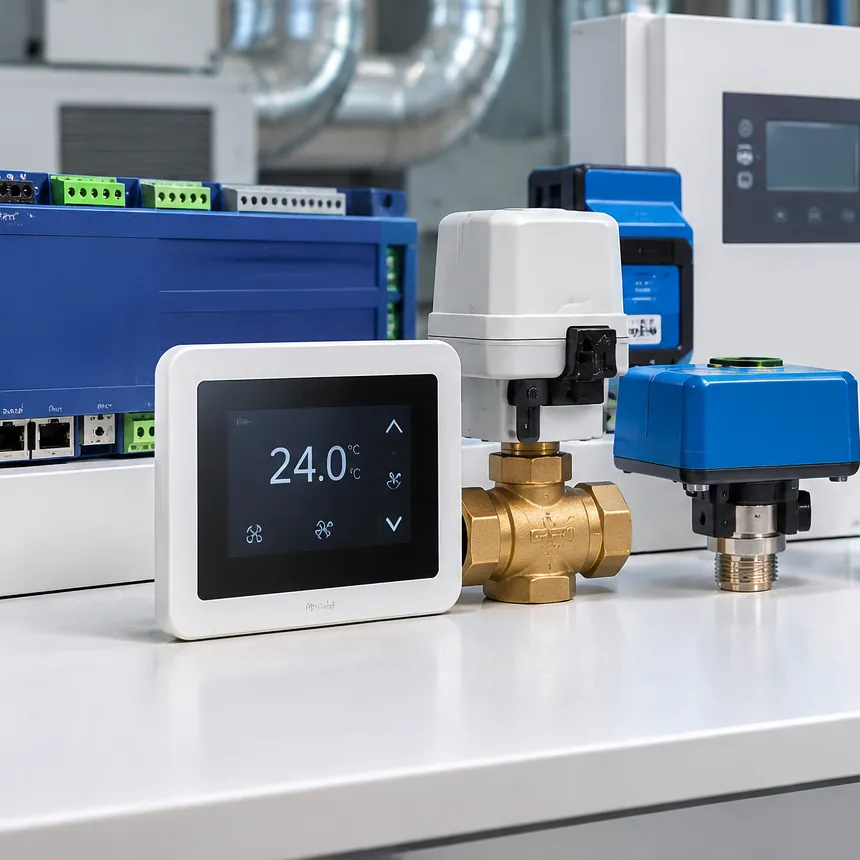
Modern HVAC systems rely on controls to monitor conditions, respond to changing loads, operate equipment, and support building management strategies. Buyers searching for JOHSON CONTROLS products are commonly referring to Johnson Controls equipment, components, sensors, thermostats, actuators, or related control solutions.
Because control components can be highly application-specific, procurement should begin with identification and compatibility rather than appearance.
Identify the Existing Control System
Replacement projects require particular care.
Before ordering a control component, record the exact model or part number of the existing device wherever possible.
Also identify:
- Equipment served
- Input requirements
- Output requirements
- Supply voltage
- Sensor type
- Control signal
- Connection arrangement
- Communication requirements where applicable
- Existing controller compatibility
This information can prevent a visually similar but electrically incompatible product from reaching the site.
Thermostats Need More Than Temperature Range
A thermostat may appear simple, but the correct product depends on how the HVAC equipment is controlled.
Fan-coil applications, packaged equipment, refrigeration systems, and other HVAC arrangements may have different control requirements.
Buyers should check the wiring configuration, operating mode, voltage, switching requirements, and supported equipment before making a replacement.
Sensors Require Correct Application Matching
Temperature, pressure, humidity, and other sensors need to provide information that the control system can correctly interpret.
A sensor with an unsuitable range or output may physically install without providing the expected control response.
This is why procurement based purely on a photograph can be risky.
Actuator Selection Needs Mechanical Compatibility
For damper or valve actuator applications, the control signal is only part of the requirement.
Torque, mounting arrangement, rotation, operating voltage, control type, and compatibility with the connected mechanical component may also need checking.
When replacing an actuator, technicians should investigate why the original unit failed. A mechanically jammed damper or valve can place unnecessary load on a replacement actuator.
Keep Project Documentation Available
Control projects often involve several parties: the consultant, MEP contractor, controls specialist, commissioning team, facility manager, and procurement department.
Maintaining accurate product schedules can reduce confusion.
For commercial buildings across Delhi, this becomes increasingly important when older HVAC systems are being repaired alongside newer controls.
Aircon Refrigeration Company supplies HVAC and refrigeration components to professional customers seeking products for maintenance and project requirements.
When enquiring about JOHSON CONTROLS products, providing the exact part number, equipment details, required quantity, and photographs of existing labels can make identification considerably more efficient.
Know When Technical Verification Is Needed
A distributor can help with product availability and identification, but system design decisions should remain with appropriately qualified project professionals.
If a replacement requires changes to wiring, control logic, communication protocols, or equipment sequences, technical verification may be necessary before purchase.
HVAC controls depend on compatibility. Taking a few extra minutes to identify the existing component accurately can prevent troubleshooting hours later. For procurement teams, accurate part numbers and system information remain among the most valuable tools for buying control products confidently.
Keywords